

In-Vehicle Embedded Software Testing: A Layered Quality Assurance Architecture
In-vehicle embedded software testing follows a strict layered verification strategy, where each layer has its unique verification objectives and value:
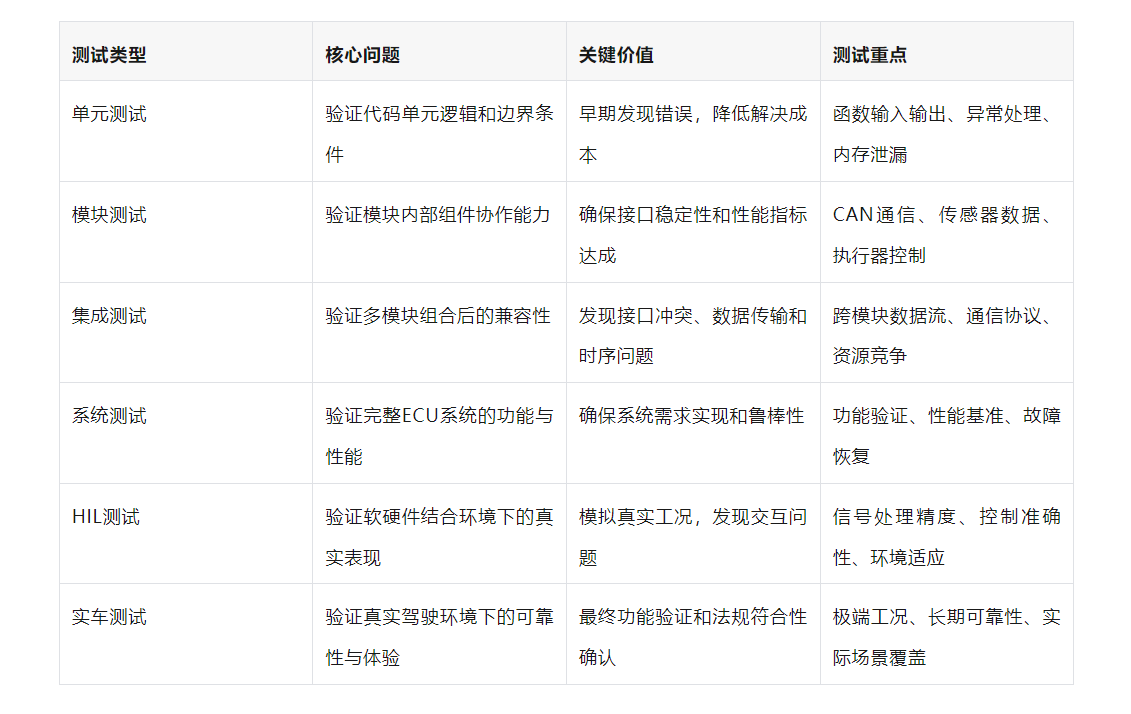
During unit testing, errors can be pinpointed down to the exact code line, and fixes are made directly on that line.
However, when testing a compiled software package, engineers can usually only identify that a function or interface has a problem, without being able to pinpoint the exact line — resulting in far more time spent modifying code.
Similarly, it is impossible to determine which code lines have been tested and which have not.
The Technical Challenge of Software Package Testing: The Real-World Dilemma of Release Verification
1. Core Needs of the Integration and System Test Phases
During integration testing and system functional testing, engineers work with fully compiled and optimized binary software packages. These packages carry the following critical verification requirements:
The Special Nature of Production-Grade Software Packages
Compiler optimization effects: Code optimized with -O2 or -O3 exhibits significantly different execution paths and performance characteristics from the development version
Real deployment environment: Reflects the memory limits and compute resource constraints of the actual ECU hardware environment
Complete functional integration: Contains all subsystem functions, reflecting real system-level interaction behavior
2. The Fundamental Technical Bottleneck of Traditional Test Tools
Current mainstream code coverage tools face an unavoidable technical contradiction when processing production-grade software packages: the inherent flaws of instrumentation technology.
Traditional tools rely on code instrumentation, an approach with fundamental problems:
Performance Interference
Execution time inflation: Instrumented code typically causes a 20–50% performance degradation
Increased memory footprint: Additional coverage data collection consumes significant memory resources
Changed cache behavior: Instrumentation alters the original program's memory access patterns, affecting cache efficiency
Code Consistency Disruption
Recompilation required: The source code must be modified and recompiled, so the resulting binary is no longer the final release version
Compromised optimization levels: To ensure instrumented code works properly, compiler optimization levels usually have to be reduced
Symbol information pollution: The introduction of debug information changes the program's memory layout and loading characteristics
Real-Time Performance Compromise
Timing characteristic disruption: For hard real-time systems such as automotive ECUs, any performance interference can cause timing violations
Interrupt response latency: Instrumentation code can affect the real-time handling of interrupts
Loss of deterministic behavior: Performance uncertainty masks potential timing issues in the original program
The core contradiction comes down to this: how can we obtain deep, code-line-level analysis data without modifying the production-grade software package in any way?
Technical Breakthrough: The Non-Intrusive Innovation of CEDARtools.Coverage
CEDARtools.Coverage, developed by Accemic Technologies GmbH, represents a fundamental breakthrough in embedded software analysis technology. Its core innovation: fully transparent monitoring of production software through hardware-level tracing technology.
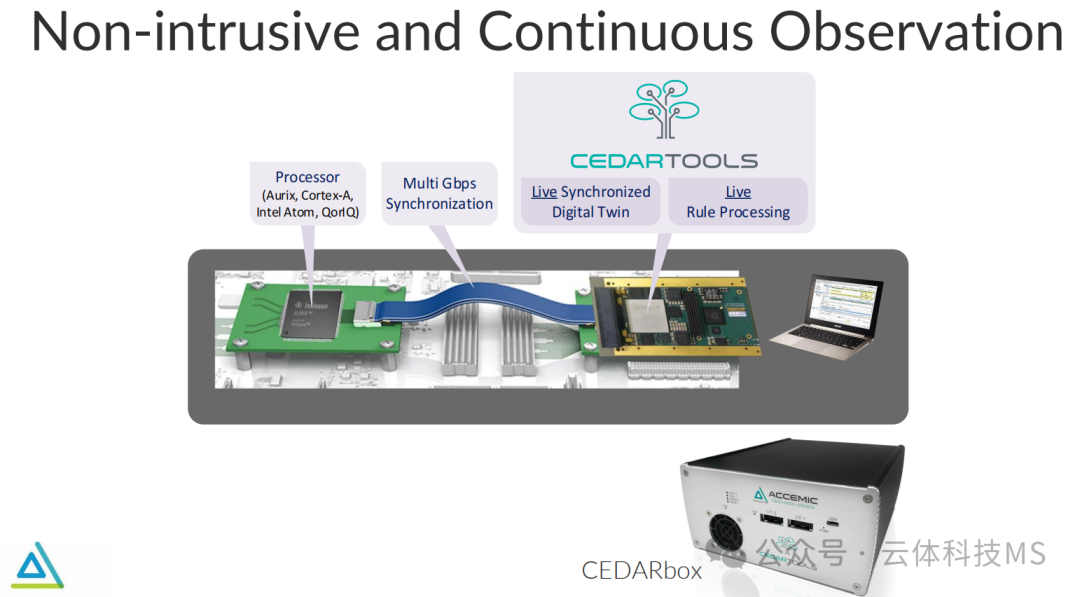
1. Truly Non-Intrusive Monitoring
CEDARtools.Coverage achieves the industry's first truly non-intrusive software analysis:
Zero code modification commitment: No source code or object files need to be modified
Zero performance overhead guarantee: Adds no CPU execution time, memory usage, or I/O overhead
Zero functional interference assurance: Does not alter any execution logic, timing characteristics, or interrupt behavior of the program
This complete non-intrusiveness ensures the absolute credibility of test results — the software being analyzed is exactly the version end users will run.
2. Real-Time High-Precision Analysis Capabilities
Microsecond-level event capture: Captures and analyzes program execution events and state changes at microsecond resolution
Instruction-level analysis precision: Tracks the execution and execution count of every machine instruction
Unlimited monitoring duration: Supports 7×24 continuous monitoring without any impact on system performance
3. The Industry's Most Comprehensive Coverage Analysis
CEDARtools.Coverage provides the most complete code coverage analysis dimensions in the industry:
Line Coverage: Execution statistics at source code line level
Branch Coverage: Execution path analysis of all conditional and loop branches
Function Coverage: Function call frequency and call relationship statistics
Condition Coverage: Truth-value combination analysis of sub-conditions within compound condition expressions
Path Coverage: Complete mapping and hotspot analysis of program execution paths
MC/DC Coverage: Modified Condition/Decision Coverage meeting the DO-178B/C standard
Who Is Accemic Technologies GmbH
Accemic Technologies is a technology company headquartered in Germany, with offices in Kirchheim bei München (Munich metropolitan area) and Dresden, and the developer of CEDARtools® — a patented breakthrough technology for dynamic analysis of reliable embedded systems.
Breakthrough Innovation in Patented Technology — Accemic has developed CEDARtools®, a patented breakthrough technology for dynamic analysis of reliable embedded systems. Its core value lies in solving complex system problems that traditional test methods cannot handle.
Industrial Case Validation — The new testing solution will be validated through industrial case studies in the aviation and autonomous driving domains, demonstrating that Accemic's technology has been practically applied and verified in the most demanding safety-critical scenarios.
Customer Recognition of Technical Value — Through its expertise and commitment to innovation, Accemic has convinced top-tier industry customers and built a broad customer base across critical sectors such as automotive, aviation, and industrial automation.
The Joint Solution of MappingSpace and Accemic
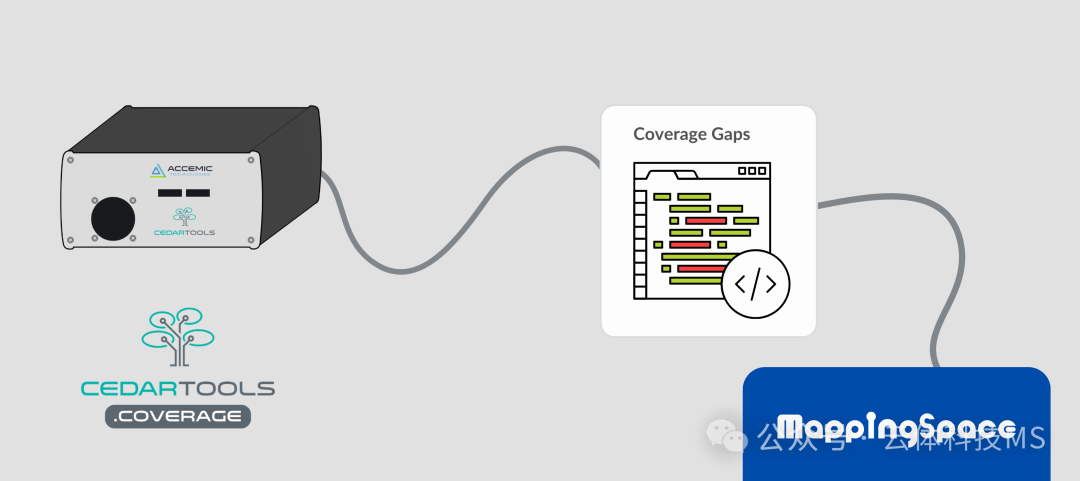
Complete Traceability from Requirements to Testing
Manage requirement baselines and test case design through the MappingSpace platform
Use CEDARtools.Coverage for precise test execution and coverage analysis
Achieve complete traceability from requirements down to code-line level
Seamless integration with existing CI/CD workflows
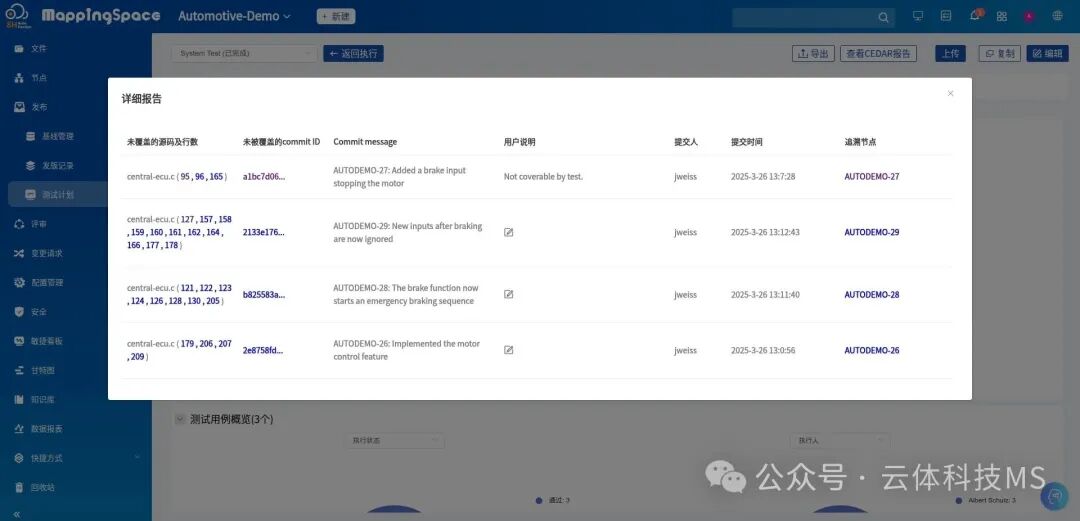
Deep Support for ASPICE and Functional Safety Processes
MappingSpace's built-in ASPICE process templates ensure process compliance
CEDARtools.Coverage provides test evidence and analysis reports that meet ASPICE requirements
Automatically generate quality documentation that complies with standards
China-Germany Software Tool Ecosystem Cooperation: Leading the Future of Automotive Software Development
The strategic partnership between MappingSpace and Accemic is not merely the combination of two excellent technology platforms — it represents an important transformation in the field of automotive software development and testing. This complete solution, from R&D management to technical implementation, offers the automotive industry a new path to address the challenges of software complexity.
We are delighted to promote this solution in both the Chinese and European markets, thereby advancing the development of the automotive industry in both regions.
Contact us to learn more about the solution. mailto:support@ytdevops.com 13817438496 (WeChat ID)